What is uptempo?
RAWTEMPO, SLOWTEMPO, KRACH… CAN YOU TELL THEM APART?
Rawtempo, slowtempo, xtra raw, krach… If you’re into hardcore, you’ll have heard all these names, and it’s not always clear where one ends and the next begins. In this guide we explain what uptempo is, where it was born, what raw is, why rawtempo and slowtempo aren’t the same even though they run at almost the same BPM, what krach is and why some kicks sound like a helicopter.
What is uptempo?
Uptempo is a subgenre of hardcore that was born in the Netherlands in the early 2010s. It’s very fast, between 185 and over 220 BPM, the melody depends on each track and what always rules is the kick: distorted, aggressive and the absolute star of the dance floor.
Uptempo in 30 seconds
- Origin: the Netherlands, early 2010s.
- Tempo: from 185 to over 220 BPM.
- Melody: depends on the track; some are very melodic and others are pure kick.
- What rules: the kick. The most typical one is the piep.
- Where to start listening: Partyraiser, Dimitri K, The Dark Horror, GPF and Noxiouz.
Where was uptempo born?
In the Netherlands, the same land that gave the world gabber. In the early 2010s, DJ Partyraiser started playing the B-sides of his records much faster. Other producers joined in and that sound, faster and more direct than the hardcore of the time, ended up with a name of its own: uptempo.
To get an idea of how it sounds today, here are Partyraiser, Spitnoise and Barber together at Masters of Hardcore 2025:
And what is raw?
Raw, also known as rawstyle, is the darkest side of hardstyle. It’s slower than uptempo, with heavily distorted kicks, screeching sounds (the famous screeches) and a tense atmosphere. Raw also covers xtra raw and rawtempo.
- Rawstyle: the foundation. A raw kick, lots of screech and little or no melody. Listen to Ran-D and Radical Redemption.
- Xtra raw: raw with harder kicks: even more violent kick drums and a punchy sound. Listen to Riot Shift, Adjuzt and Rebelion.
Watch the BPM: raw doesn’t have a fixed one. It’s played in several ranges, from 80 to 130 BPM or from 140 to 170 BPM.
Rawtempo, where raw meets uptempo
What happens if you put the two together? Raw + uptempo = rawtempo. It’s raw mixed with any kind of uptempo: the tempo and darkness of raw with uptempo kicks. It hits just as hard, but leaves more space between beats.
Who plays it in their sets? For example Rayzen (Belgium), Dual Damage (Netherlands), The Straikerz (Barcelona) and KEMAL (Turkey). These are just a few and, note, many of them are rooted in raw and xtra raw: they bring out rawtempo when they mix raw with uptempo.
Here’s Rayzen with a rawtempo and uptempo set at Harmony of Hardcore 2025:
Are rawtempo and slowtempo the same?
No. Slowtempo is uptempo at lower revs: its kick, its melodies and its energy, but slower. Many tracks are edits and remixes of uptempo tracks, and it’s the big trend of 2026: it already has its own place on line-ups, such as Slow Down in the Netherlands.
| Style | Where it comes from | How it sounds |
|---|---|---|
| Rawtempo | From raw | Dark, tense, with screeches and uptempo kicks |
| Slowtempo | From uptempo | Its kicks and its vibe, but slower |
Both sit around 160 BPM, but as soon as you hear them you can tell them apart: same BPM, different sound. To hear slowtempo, try Krowdexx, Noiseflow and Lekkerfaces. For example, Krowdexx and Kenai’s «Move It» in its slowtempo version:
What is krach?
Krach means “noise” in German, and it’s the German version of uptempo. In July 2023, Noiseflow named its sound Deutscher Krach, and it hasn’t stopped growing since.
More than by its speed (there are tracks from 130 BPM to over 200), krach is recognised by its sound: extreme kicks, heavily saturated bass, hardstyle melodies and euphoria instead of darkness, with choruses in German and plenty of humour.
- Tempo: from 130 to over 200 BPM.
- Origin: Germany.
- Since: 2023.
- Where to start listening: Noiseflow, Schlot, Cyber Gunz and Dr Donk.
To understand it, nothing beats Noiseflow’s «Nur noch Deutscher Krach»:
Uptempo kicks, piep, zaag and helicopter
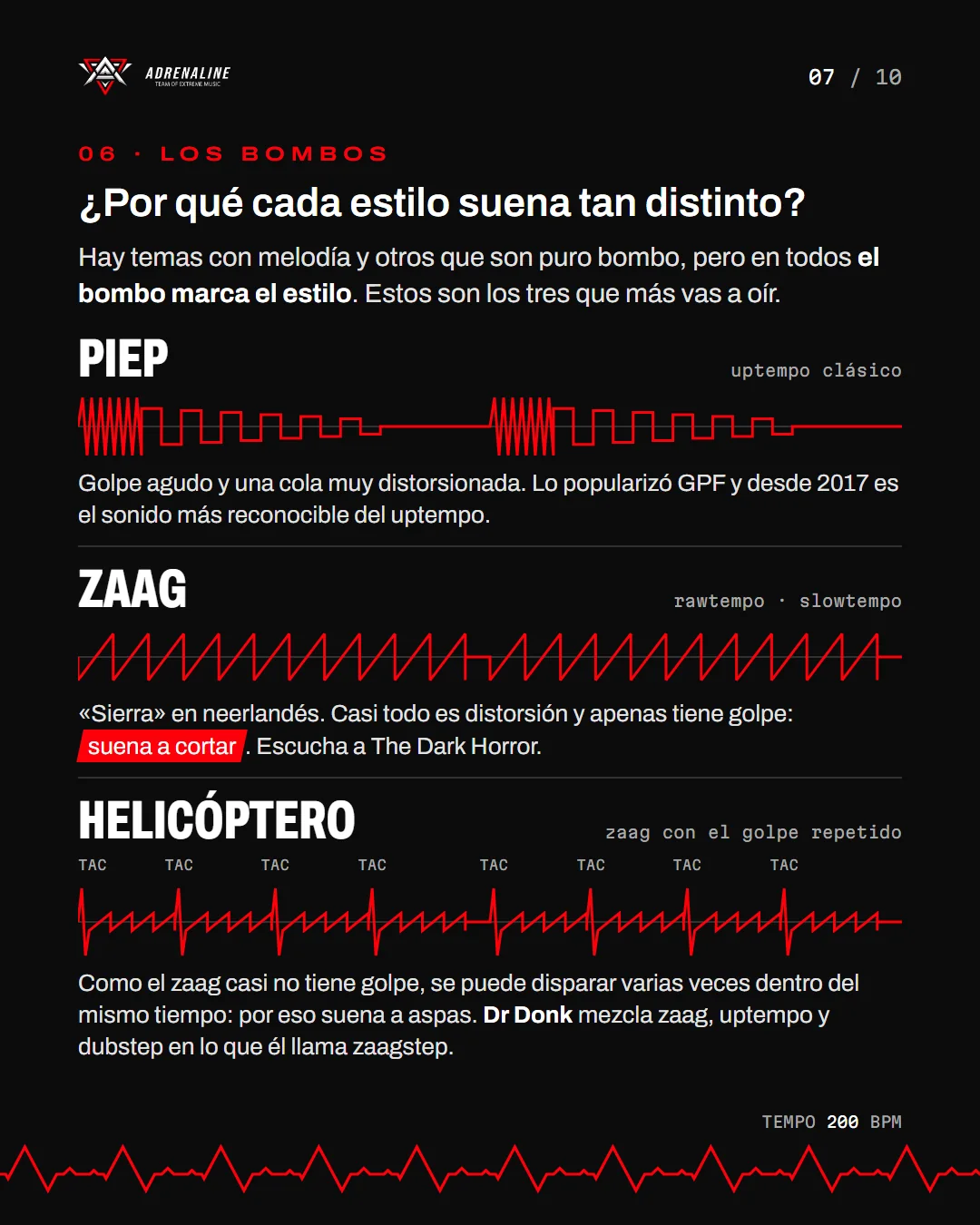
Why does each style sound so different? Some tracks have melody and others are pure kick, but in all of them the kick defines the style. These are the three you’ll hear most.
Piep, the classic uptempo kick
A sharp hit with a heavily distorted tail. It was popularised by GPF and since 2017 it has been the most recognisable sound in uptempo.
Zaag, the kick of rawtempo and slowtempo
Zaag means “saw” in Dutch. It’s almost all distortion and has hardly any punch: it sounds like cutting. Listen to The Dark Horror, for example «Zaag Machine».
Helicopter, the zaag with a repeated hit
Because zaag has almost no punch, it can be triggered several times within the same beat: that’s why it sounds like helicopter blades. Dr Donk mixes zaag, uptempo and dubstep into what he calls zaagstep.
And to hear the piep in action, GPF and Dr Donk together on «Piep Caroline»:
Not everything is uptempo, terror and frenchcore
Terror? Frenchcore? Is it the same thing? No. They’re similar in speed or in kick, but each one has its own story.
Terror (over 200 BPM)
It’s older: it was born in the early 90s, also in the Netherlands. It usually goes even faster and more distorted than uptempo. Listen to Drokz and Noisekick.
Frenchcore (around 200 BPM)
Same tempo as uptempo, different character: an offbeat distorted bass and more melody. It was born in the mid-90s between France and the Netherlands. Listen to Dr. Peacock and Sefa.
If you want to compare, here’s Dr. Peacock’s «Frenchcore Worldwide»:
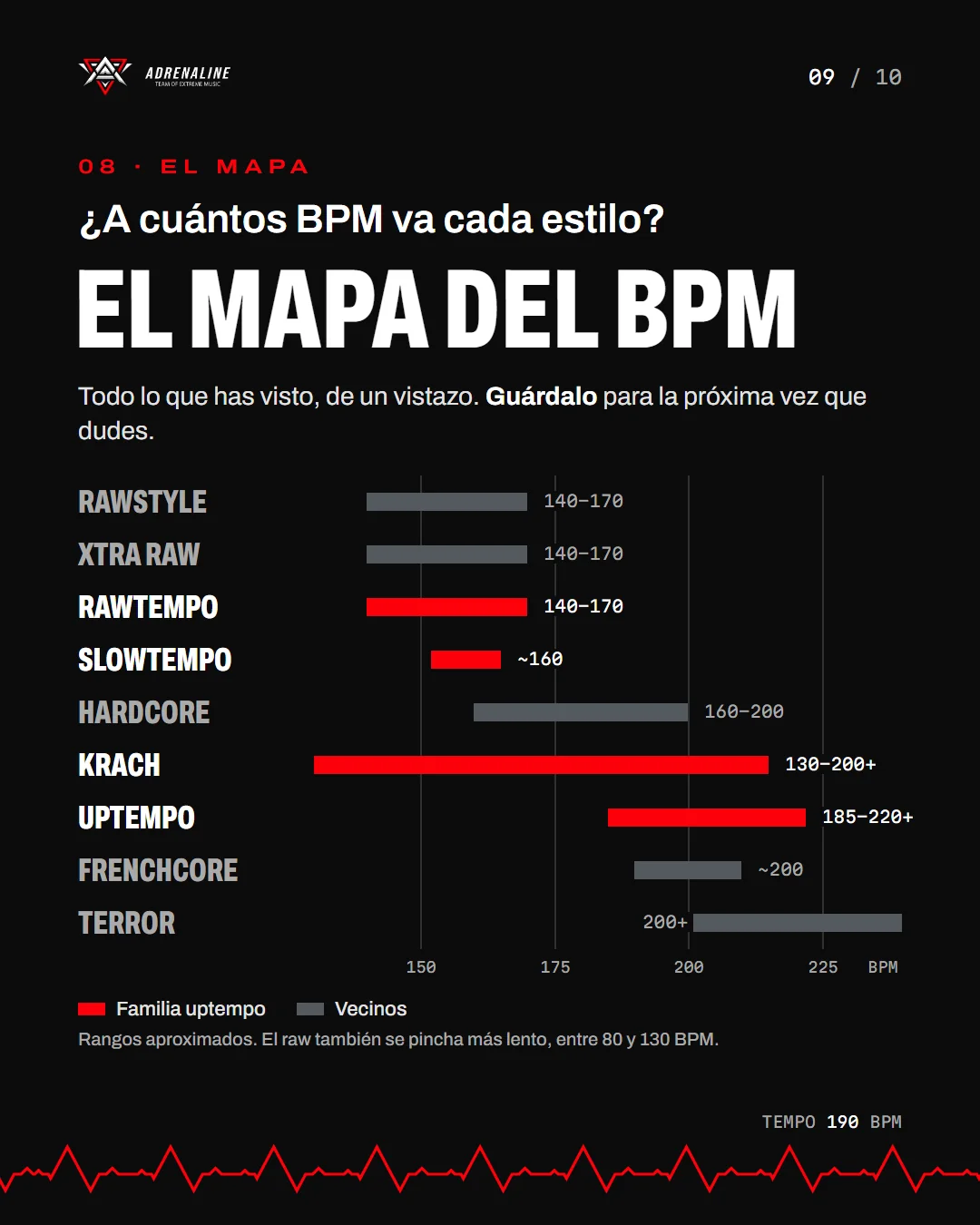
The BPM map, how fast does each style go?
Everything you’ve seen, at a glance. Save it for the next time you’re not sure.
| Style | Approximate BPM | Family |
|---|---|---|
| Rawstyle | 140–170 | Neighbour |
| Xtra raw | 140–170 | Neighbour |
| Rawtempo | 140–170 | Uptempo family |
| Slowtempo | ~160 | Uptempo family |
| Hardcore | 160–200 | Neighbour |
| Krach | 130–200+ | Uptempo family |
| Uptempo | 185–220+ | Uptempo family |
| Frenchcore | ~200 | Neighbour |
| Terror | 200+ | Neighbour |
Approximate ranges. Raw is also played slower, between 80 and 130 BPM.
How do you dance to uptempo?
At these speeds, the dance par excellence is hakken, the fast footwork born in the gabber scene in the Netherlands and danced mostly to millennium and uptempo. If you want to see the other styles, check out the guide to ways to dance hardcore. And if you’re in Madrid and want to learn, at Adrenaline we run hakken workshops.
Frequently asked questions about uptempo
How many BPM is uptempo?
Usually between 185 and 220 BPM, and some tracks go beyond 220.
Who created uptempo?
The sound took off in the early 2010s in the Netherlands, when DJ Partyraiser started playing the B-sides of his records much faster and other producers joined in.
What’s the difference between rawtempo and slowtempo?
They sit around the same BPM, but rawtempo comes from raw (dark, tense and full of screeches) and slowtempo is uptempo at lower revs, with its kicks and its melodies.
What’s the difference between uptempo and frenchcore?
They run at a similar tempo, but frenchcore has an offbeat distorted bass and more melody, and it’s older: it was born in the mid-90s between France and the Netherlands.
What is the piep in uptempo?
It’s the most typical uptempo kick: a sharp hit with a heavily distorted tail. GPF popularised it and since 2017 it has been its most recognisable sound.
What’s your favourite?
Tell us on Instagram and let us know what you’d like us to talk about in the next article. And if you know someone who still calls everything “uptempo”, send it to them.